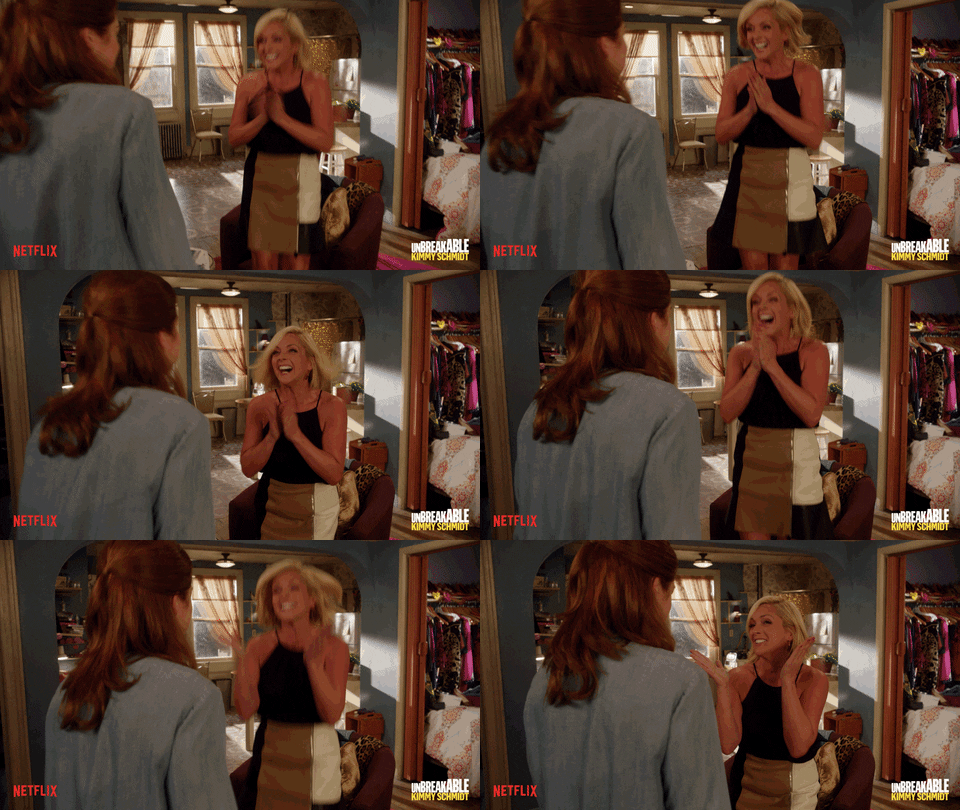
*This blog post theme is on Unbreakable Kimmy Schmidt... prepare yourself for a lot of gifs, and a lot of gifs= long blog post*
We hold these truths to be self-evident, that the Declaration of Independence, although written with the best intentions, comes with the implication that the "certain unalienable Rights, that among these are Life, Liberty, and the pursuit of happiness" aren't always applicable to women, Native Americans, African Americans, and other minorities (Jefferson 120). These implications, although originated from a document written 240 years ago, are the catalyst for the social injustices and prejudice still present today.
Although women have taken many strides towards equality--from suffrage to Roe v. Wade--we're still not there yet. Even worse, efforts to reach equality are looked down upon by all too many, the same people (including celebrities) who often use the media to talk down feminism, causing misconceptions about what the term means to form.

Let's get something straight: feminism is NOT just an outlet for shrill and whiny women to complain for more power. On the contrary, it's to create an equality between genders. After all, isn't that what democracy is all about, the notion that everyone is created equal? If that's the case, then please explain to me why a mom can't be a working mom. Please explain to me why that working mom can't make as much as a man. Please explain to me why instead of teaching young males not to objectify their female counterparts, girls are taught that showing too much shoulder means being a "slut". Please explain to me why rape victims are berated with degrading questions--"What were you wearing? How much alcohol had you consumed? Did you do anything to provoke it?", while the Brock Turners of the world walk free after only three short months. Please explain to my clueless, female brain how those delineate an equal society...but make sure to speak slowly, I wouldn't want to get confused.


I am aware that the majority of police officers don't act with this level of
prejudice, instead risking their lives to protect us every day. I'm just
feeling a little cynical at the moment.
Similarly, the Native Americans have been exploited and taken advantage of ever since the first settlers came. In a way, they are still seen as less than a citizen; for hundreds of years, their land has been taken from them without compensation, although if another citizen's land had to be taken by the government for a project (for instance, to build a pipeline), the citizen would be compensated for property's market value. What message are we sending to Native Americans if we don't give them the same treatment? That they are less than a citizen, less than a person? We should be gracious and respectful to Native Americans, as the land we live on was originally theirs, not the other way around. Instead, Native American culture is exploited and trampled over on a daily basis; sports teams like the "Redskins" or the "Indians" continue to maintain their brand, ignoring the fact that their names are seen as disrespectful, and those who don't assimilate to American culture are seen as stuck-in-their-ways. But why? If our culture is really the greatest of them all, how can we expect to be seen as such by oppressing those who disagree? Seems a little illogical to me, but then again, our whole country was built on one logical fallacy after another...

Jackie-Lynn "Jacqueline", a rich socialite portrayed as only
gaining her status after abandoning her Native-American roots
Of course I can't say that I've experienced all of these injustices (in fact, some of my most traumatic experiences pale in comparison to those mentioned earlier in this post), but being a part of a minority in this country does come with some downfalls. I notice everything, from the exasperated eye-rolls as people look into my mom's car to see that the clueless driver is *obviously* Asian to the fact that virtually no Asian-Americans are present in the Hollywood, even in roles traditionally written for those of Asian descent.
But why is it so easy to let the majority crush the minority under their stereotypes and expectations? After all, minorities apart make up the majority together. I'm not saying that minorities should start a revolution to overthrow the so-called majority or anything, but maybe one day, we can take down these social barriers and finally create a society in which every man, woman, and child (of every race) is truly created equal.

(I PROMISE THAT I'M NOT AS CYNICAL AS THIS BLOG POST MAKES ME OUT TO BE)